

Operational performance requires diagnosis before design.
Operational performance is engineered through structure.
WORK WITH ME
How Operational Performance Is Evaluated
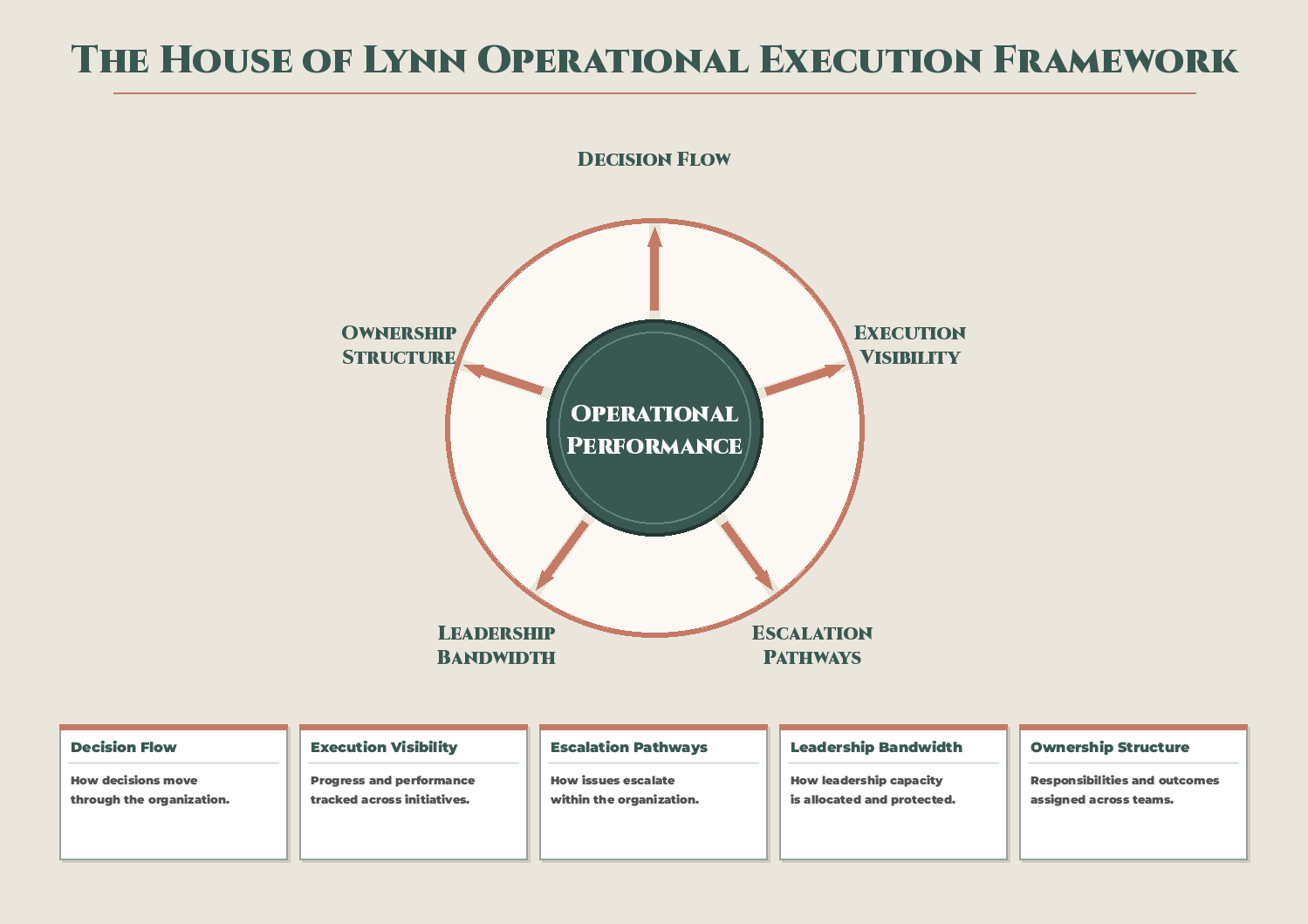
The Executive Performance Audit analyzes five structural drivers that influence how execution moves through an organization.
These elements form the operational infrastructure that determines whether work flows efficiently or stalls under pressure.
STEP 1: Operational Execution Assessment
A short complimentary diagnostic to identify early signals of execution friction and determine whether deeper evaluation is appropriate.
The Executive Performance Audit is a structured diagnostic engagement designed to analyze how decisions, ownership, and execution flow through your organization.
The goal is to identify structural drivers behind operational friction before any systems or solutions are introduced.
Includes:
• Pre-work review
• 90-minute deep diagnostic session
• Infrastructure gap mapping
• Prescribed 30-day roadmap
Investment begins at $3,500.
STEP 2: Executive Performance Audit
STEP 3: Prescribed Pathway
After the Audit
Based on the findings of the Executive Performance Audit, one of the following pathways may be recommended:
Operations Infrastructure Build - A structured implementation engagement designed to install the systems, delegation architecture, and accountability frameworks identified during your audit. This is where operational clarity becomes operational stability.
Executive Partnership - An application-based advisory partnership for leaders who require continued operational oversight, refinement, and performance protection as their organization scales. This ensures structured execution remains the standard and not the exception.
This diagnostic assessment is provided as a complimentary first step for qualified organizations.
Frequently Asked Questions
-
The Operational Execution Assessment is the first step in the process.
It is a brief diagnostic designed to surface early signals around how work currently moves through your organization. The assessment explores areas such as ownership clarity, decision pathways, visibility into execution, and leadership involvement.
Its purpose is not to provide a full diagnosis, but to identify whether deeper structural review may be valuable.
Organizations experiencing recurring execution friction, leadership overload, or unclear operational structure may benefit from the next step in the process.
-
After you complete the Operational Execution Assessment, I review your responses to understand how work, decisions, and accountability currently move through your organization.
If the responses suggest that structural execution challenges may be present, you may be invited to submit the Executive Performance Audit application. From there, we determine whether a deeper diagnostic review would be valuable.
The goal of the assessment is simply to create visibility into whether a structural review may help strengthen operational performance.
-
The Executive Performance Audit is the structured diagnostic that follows the assessment for organizations that may be experiencing structural execution challenges.
During the audit, we examine how work, decisions, and accountability move through the organization. This review helps identify infrastructure gaps, delegation breakdowns, and operational friction that may be slowing execution.
Beginning with a diagnostic ensures that any future improvements are based on clear understanding rather than assumption.
-
Once the audit is complete, we review the findings together during an alignment session.
This conversation allows leadership to understand where execution friction is occurring and which structural adjustments would have the greatest impact. If additional support is appropriate, we then design the operational systems needed to stabilize execution and strengthen organizational infrastructure.
-
This work is most valuable for organizations that are growing or experiencing increased operational complexity.
Leaders often reach out when they notice patterns such as decisions slowing down, ownership becoming unclear, teams waiting for direction, or leadership capacity becoming stretched across too many operational details.
These signals often indicate that the organization has outgrown the structure supporting its execution.
-
Not exactly.
Many consulting engagements begin by recommending new tools, processes, or management systems.
My approach begins with diagnosis. Before introducing any solution, we first examine how execution actually moves through the organization. This ensures that structural gaps are addressed at their source rather than patched with additional processes.
-
The initial steps are designed to move efficiently while still allowing for meaningful analysis.
The Operational Execution Assessment typically takes only a few minutes to complete. If the assessment suggests that deeper review may be helpful, the Executive Performance Audit is scheduled shortly after.
From there, timing depends on the scope of the organization and the structural areas being evaluated.
-
Many organizations attempt to solve execution challenges by introducing new tools, workflows, or management routines.
While those elements can be helpful, they rarely address the underlying structure that determines how work moves through the organization.
Operational infrastructure refers to the systems that define ownership, decision authority, execution visibility, and escalation pathways.
When these elements are clear, tools and processes tend to work effectively. When they are not, even well designed systems struggle to produce consistent results.
-
The work is generally most valuable once an organization has reached a stage where teams, delegation, and decision structures are beginning to form.
Early-stage founders are still building many of these elements. The audit process is designed for organizations that are navigating growth and beginning to experience operational complexity.
-
Many leaders begin exploring this work when they notice recurring execution patterns.
Decisions returning to leadership too often.
Teams waiting for direction instead of moving forward.
Meetings increasing without improving execution.
Growth creating pressure on leadership capacity.These patterns often signal that operational infrastructure has not yet evolved alongside the organization’s growth.
-
The Executive Performance Audit is a standalone diagnostic engagement.
By the end of the process, you will have a clear understanding of how work, decisions, and accountability currently move through your organization, along with a prioritized set of recommendations for strengthening execution.
Some organizations choose to continue with implementation support. Others use the findings internally.
Either way, the goal of the audit is clarity.
-
The Executive Performance Audit is designed to respect leadership capacity.
Most organizations participate in one structured diagnostic session, along with a short period of information sharing beforehand so we can understand how work currently moves through the organization.
The majority of the analysis is conducted independently.
The goal is to generate meaningful operational insight without adding unnecessary demands to the leadership team’s time.
-
My work focuses on operational infrastructure rather than day to day administrative support.
I partner with founders and executive leaders to evaluate how work, decisions, and accountability move through the organization. The goal is to strengthen the systems that allow teams to operate effectively and leadership to focus on strategic priorities.
In some cases, the audit may reveal opportunities to improve how executive support functions are structured. When that occurs, recommendations may include clarifying responsibilities, improving delegation pathways, or strengthening operational support systems.
-
The goal of this work is to strengthen the infrastructure behind execution.
Organizations that move through the assessment and audit process typically gain clearer ownership structures, more defined decision pathways, improved visibility into work, and greater protection of leadership capacity.
When these elements are clarified, teams move forward with less friction and leaders spend less time managing execution directly.
Operational performance becomes more stable because the structure supporting it has been intentionally designed.